STRUCTURAL ENGINEERING PRODUCTION
Foundation Design
Spread footing, mat, and deep foundation production support developed from your engineer’s geotechnical basis
and load criteria.
Our Founding and Mission
Introduction
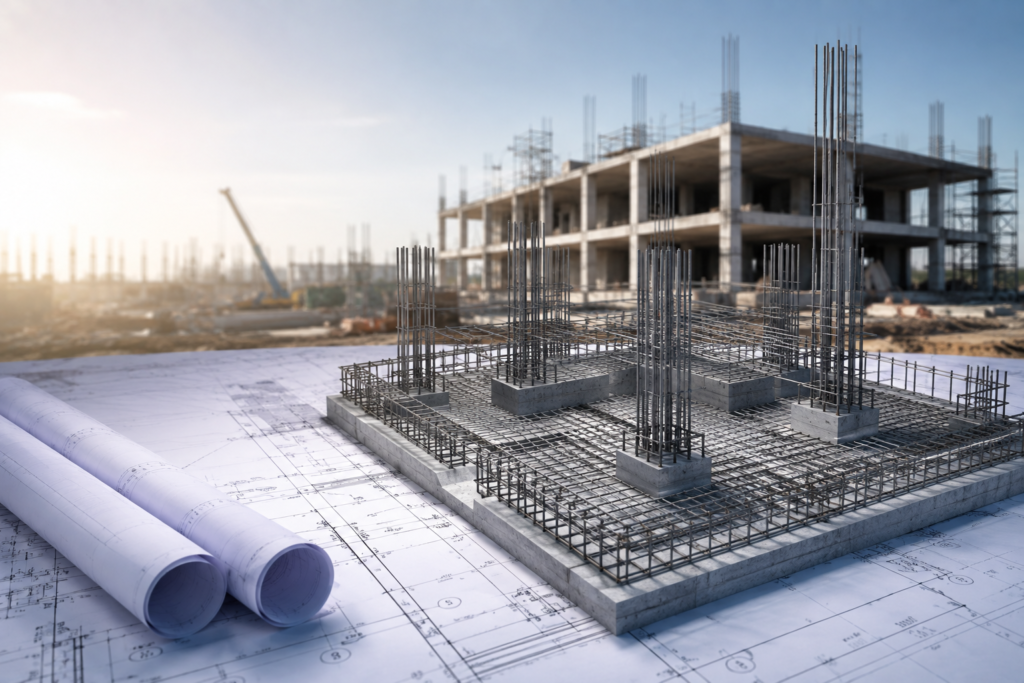
NexMEP Global LLC supports U.S. structural and MEP consulting firms with foundation design production, developing footing layouts, foundation plans, and deep foundation documentation from your engineer’s geotechnical report parameters and structural load criteria. Our team carries foundation layout through each design phase while your licensed structural engineers retain full authority over foundation type selection, bearing capacity assumptions, and settlement criteria.
We work from the column and wall reactions, geotechnical bearing capacity, and foundation type your engineer has established, producing coordinated documentation that reflects that design intent accurately, consistent with the below-grade coordination this scope requires with civil and mechanical disciplines.
DESIGN ACCURACY & COMPLIANCE
Why This Service Matters
Foundation design translates the structural loads from the entire building above into a system that must perform reliably in the specific soil conditions documented in the project’s geotechnical report, making accurate load transfer and geotechnical parameter application essential from the earliest layout. Because foundations are also typically the first element constructed, foundation documentation errors are often discovered only after excavation has begun, when correction is far more disruptive and costly than at almost any other phase of construction.
Production support allows this detail-intensive, sequence-critical documentation to be developed carefully alongside the rest of the structural design, keeping foundation layout, reinforcing, and elevation documentation synchronized with the geotechnical report and your engineer’s load calculations throughout the design process.
Our Capabilities
Spread & Continuous Footing Plans
Layout and detailing of shallow footings matched to column/wall reactions and soil capacity.
Deep Foundation System Layouts
Documenting driven/drilled piles, caissons, piers, grade beams, and pile cap configurations.
Mat & Raft Foundation Detailing
Developing full mat foundation layouts for high-load or low-bearing-capacity site conditions.
Below-Grade & Basement Walls
Coordinating foundation walls with waterproofing, drainage, and retaining conditions.
Stepped Footing & Sloped Sites
Documenting stepped bearing elevations to meet horizontal-to-vertical step requirements.
Renovation & Underpinning Support
Detailing new foundation elements adjacent to or bearing on existing structures.
Calculations
Engineering Calculations
Calculation methodology built for accurate, traceable HVAC equipment sizing.
Footing Sizing & Elevation Backup
Verification of footing areas against soil bearing capacity, column reactions, and code-required founding depths.
Deep Foundation & Reaction Audits
Compiling pile and caisson capacity summaries cross-referenced directly to the geotechnical report design criteria.
Calculations
Systems We Support
Ventilation-related calculation support includes outdoor air rate compilation.
Shallow Footing Systems
Spread, isolated, continuous strip, and combined footing layouts.
Mat & Raft Foundations
Heavy reinforced concrete mats for high-rise or soft-soil applications.
Drilled Caissons & Piers
Large-diameter deep foundation elements designed for rock or deep strata.
Driven & Drilled Piles
Steel H-piles, pipe piles, precast concrete, and augercast pile arrays.
Grade Beams & Pile Caps
Interconnected structural grade beams and multi-pile cap arrangements.
Specialized Geotechnical Conditions
Layouts engineered for expansive soils, high water tables, or liquefaction.
Our foundation production capabilities cover both shallow and deep substructure types, ensuring precise load-path documentation and below-grade clearance coordination.
Calculations
Software, Workflow & Coordination
Rigorous backup calculations formatted directly for permit submission and QA/QC documentation.
Software & Production Workflow
Modeled in Revit and AutoCAD using your firm’s standards. Workflows include dedicated verification steps cross-referencing foundation elevations directly against geotechnical boring logs and groundwater table data.
Revit & AutoCAD Coordination
Foundations are clash-tested in Navisworks against civil site grading, utility entry points, and under-slab MEP piping. We flag any pipe sleeve or utility penetration that conflicts with foundation steel or bearing zones.
Calculations
Systems We Support
Expertise across diverse equipment lines, hybrid configurations, and complex Electrical setups.
Foundation Layout Plans
Footing & Pile Schedules
Foundation Sections & Details
Geotechnical Calculation Backup
Need Sequence-Critical Foundation Production Support?
Partner with NexMEP Global LLC for accurate footing layouts, deep foundation plans, and civil/MEP coordinated sub-grade modeling.
Our Core Philosophy
Typical Project Types
Commercial & Multi-Family
Office buildings, multi-family residential towers, and mixed-use complexes.
Education & Healthcare
K-12 schools, university academic buildings, and hospital additions.
Industrial & Logistics
Light industrial facilities, high-bay warehouses, and heavy equipment pads.
Renovations & Additions
Structural retrofits requiring underpinning, shoring, or infill foundations.
Calculations
QA/QC Process
A rigorous, multi-tiered review structure ensuring accurate, clear, and error-free submittals.
Geotechnical Parameter Audits
Verification of footing dimensions against geotechnical report bearing capacities and recommended depths.
Framing Reaction Verification
Comprehensive Navisworks passes ensuring framing clearances match architectural and MEP requirements.
Plan-to-Section Elevation Checks
Independent secondary checks confirming every plan mark appears on the schedule with zero missing entries.
Why NexMEP Global LLC?
NexMEP Global LLC brings a dedicated production team with practical experience across standard and specialty ventilation systems, a consistent U.S. code and standards focus, and a multi-level QA/QC process that reduces rework during your engineer’s review cycle.